Embedded debugging
View clocks, resets, GPIO, PWM and analogue behaviour together. Four channels are valuable when a fault depends on timing between several signals.
UK buyer's guide
The Rigol DS1054Z is popular because it gives engineers, students and electronics hobbyists four channels, deep memory and practical debug features in a compact benchtop oscilloscope.
£312.00 ex VAT
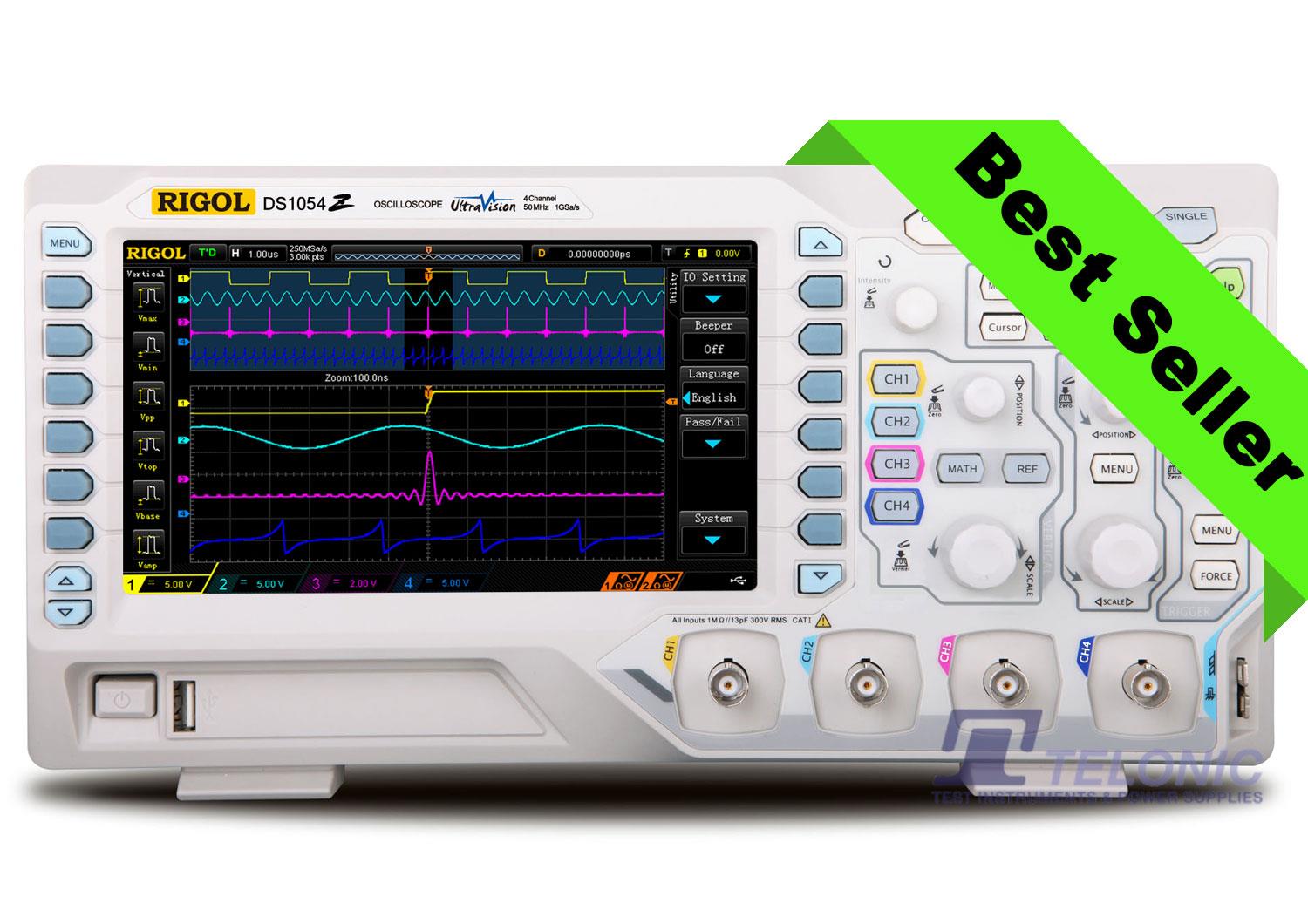
The DS1054Z sits in the sweet spot for people who need a real bench oscilloscope without moving straight into higher-cost professional instruments. It is especially attractive when a project needs more than two channels: power rails, serial signals, clocks and sensor outputs can be viewed together instead of in separate captures.
It is a sensible choice for embedded electronics, education labs, repair benches, prototyping and hobby electronics. For many buyers the key argument is not only price; it is the combination of four channels, waveform capture depth, serial decode options and a familiar front-panel workflow.
View clocks, resets, GPIO, PWM and analogue behaviour together. Four channels are valuable when a fault depends on timing between several signals.
Its price-to-capability balance makes the DS1054Z a practical candidate for benches where learners need hands-on oscilloscope time.
Beginners can grow into four channels, measurement tools and deeper capture memory instead of quickly outgrowing a basic two-channel model.
| Bandwidth | 50 MHz |
|---|---|
| Channels | 4 analogue channels |
| Maximum sample rate | Up to 1 GSa/s |
| Memory depth | Up to 24 Mpts |
| Waveform capture rate | Up to 30,000 wfms/s, according to Rigol's DS1000Z series datasheet |
| Display | 7-inch WVGA colour display |
Use the DS1054Z to check frequency, duty cycle and signal quality on microcontroller PWM outputs.
Compare sensor power, output and timing lines to find whether a problem is hardware, wiring or firmware.
Inspect noise, dips and load-related problems that a multimeter can easily miss.
Compare input and output waveforms to see filtering, gain, clipping and analogue circuit behaviour.
Use the DS1054Z to help students compare source, output, timing and supply signals on one screen.
Check power rails, clocks, resets and signal paths to isolate dead or intermittent boards.
Compare reset, clock, GPIO and peripheral response signals when event order matters.
Capture startup, load response and rail interaction problems that static readings miss.
The DS1054Z's four channels make it easier to debug timing relationships. If you work on microcontroller boards, power sequencing or mixed analogue and digital problems, the extra inputs can matter more than headline bandwidth.
Higher-bandwidth scopes can be the correct choice for faster edges and RF-adjacent work. For general electronics, education and many embedded projects, the DS1054Z remains a strong value-led option.
5 / 5 from 28 verified buyer reviews
Great scope. For the price I must say that is a best buy. It came with all functions unlocked. Fast delivery and great support from Telonic.
Good scope at a good price, delivered overnight using standard free delivery option.
Great scope for my budget. Slightly heavier than expected. Thanks Telonic!
I ordered the scope at 2.30 in the afternoon using the standard free delivery. It arrived before 10.00 am next morning. The scope is extremely good value for money.
Nice piece of kit at a good price delivered quickly and without fuss.
Latest price £312.00 ex VAT at Telonic (checked 2026-09-14). Prices can change, so confirm the current offer on the product page before purchase.